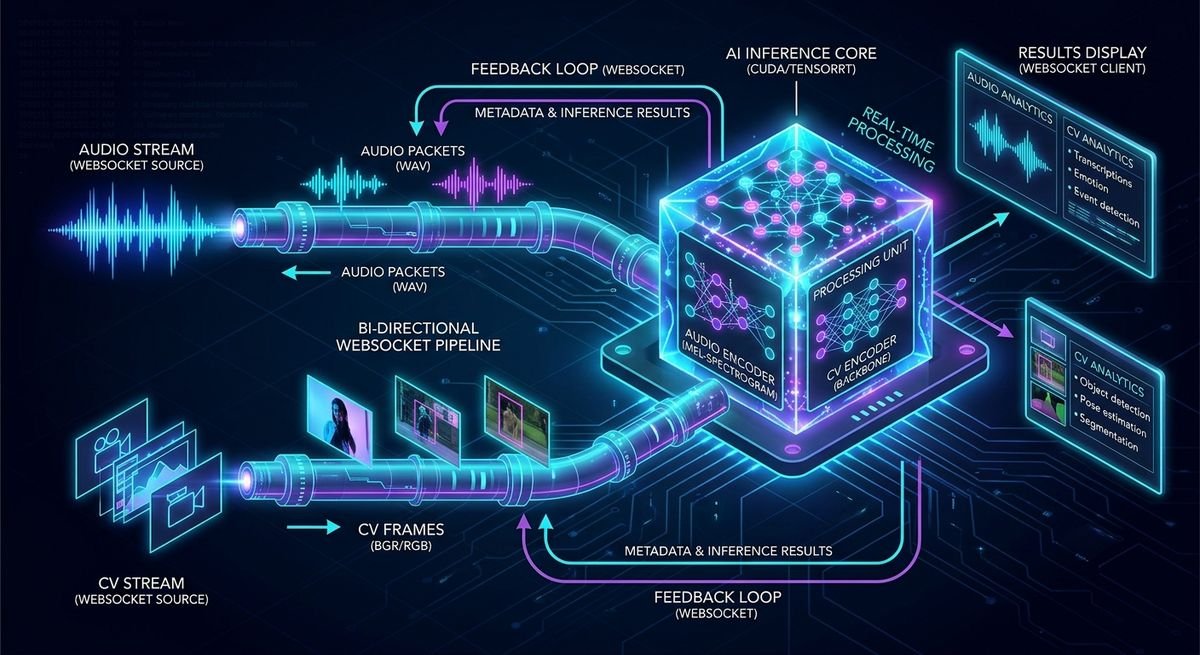
Streaming Multimodal Data with WebSockets
When building our real-time voice assistant at Klubhub, HTTP REST endpoints choked immediately. Processing combined audio chunks and video frames created severe latency bottlenecks. Consequently, we migrated our ingress infrastructure entirely to full-duplex WebSocket connections. Multimodal AI Streams require bidirectional streaming to process continuous payload tokens without connection overhead.
Standard Server-Sent Events (SSE) work well for unidirectional text streaming. However, real-time interactive vision and speech demand rapid client-to-server feedback loops. Therefore, WebSockets provide the necessary framing mechanism for multiplexing audio bytes and JSON metadata. For detailed socket standards, refer to the MDN WebSocket API guide.
async def handle_multimodal_stream(websocket):
    async for message in websocket:
        payload = json.loads(message)
        if payload["type"] == "audio":
            await process_audio_chunk(payload["data"])
        elif payload["type"] == "frame":
            await process_image_frame(payload["data"])
Architecting Multimodal Real-Time Pipelines
During initial testing, unbounded memory usage crashed our ingestion workers. Audio PCM buffers accumulated faster than our inferencing engine could evaluate them. Consequently, we implemented backpressure mechanisms directly within the stream handler.
Streaming Multimodal Audio Protocols
We sliced input raw PCM audio into 20-millisecond window packets. As a result, latency dropped significantly across active connections. Furthermore, client applications received immediate stream acknowledgment payloads.
{
  "event": "media_chunk",
  "mime_type": "audio/pcm;rate=16000",
  "sequence": 1042,
  "payload": "b64_encoded_binary_bytes=="
}
Streaming Multimodal Vision Frames
Sending high-resolution JPEG frames over active sockets overloads memory bandwidth. Therefore, we sample video at five frames per second during active speech. Furthermore, framing logic drops unchanged visual context to optimize throughput. Multimodal AI Streams depend on efficient frame rate management to preserve server compute resources.
Production Considerations for Engineers
Deploying streaming infrastructure requires robust state recovery and socket reconnection strategies. For engineering inquiries or technical consulting, visit our tech blog overview or reach out via email contact.
Lessons learned from our deployment:
- Always enforce binary frame encoding over JSON when throughput exceeds 1MB/s.
- Implement explicit backpressure signals to prevent memory exhaustion on inferencing nodes.
- Ping-pong heartbeats must run asynchronously to maintain connection health during heavy computation.