Architectural Bottlenecks in Stream Routing
I built our real-time video engine at Klubhub to handle high-concurrency streams. However, single-threaded backend architectures quickly fail under heavy WebRTC traffic load. Standard WebRTC peer-to-peer mesh networks degrade rapidly as participant counts increase. Therefore, shifting to a Selective Forwarding Unit architecture becomes essential for performance.
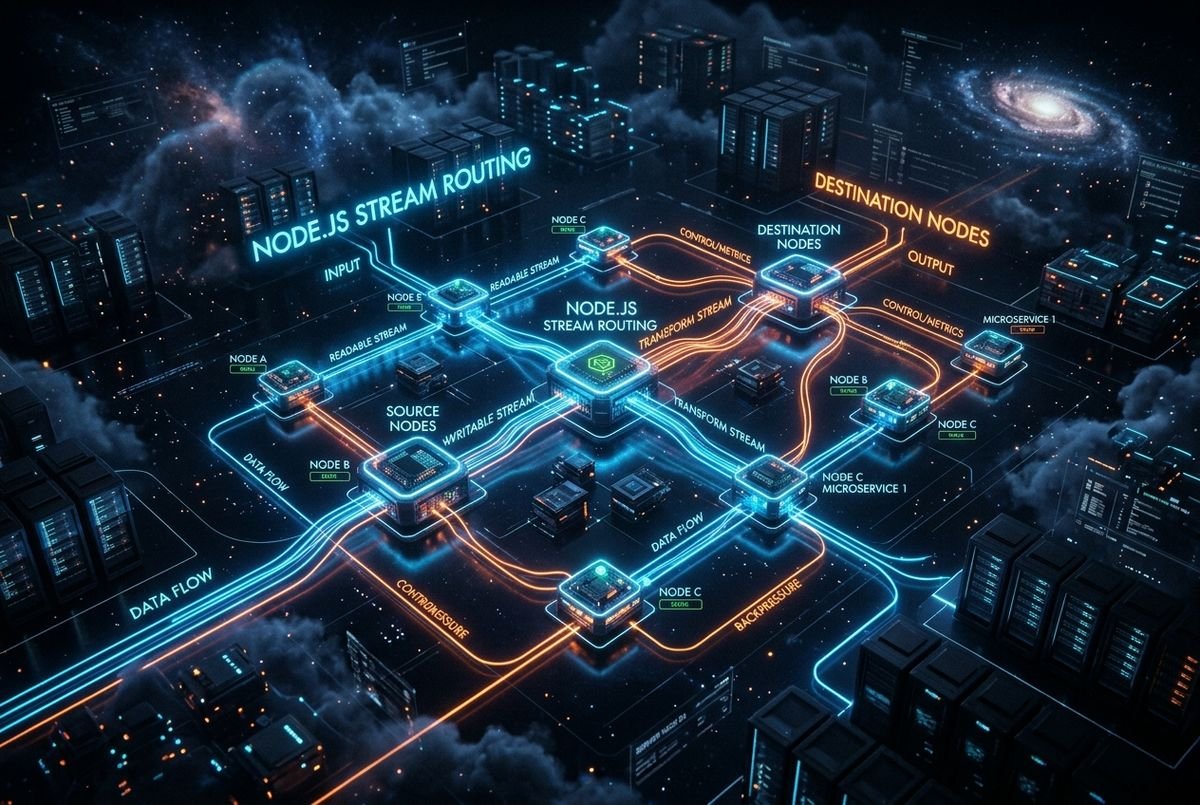
In this setup, Nodejs video stream routing manages application signaling without touching packet transport. The central application process coordinates peer connection handshakes and session state events. Meanwhile, native worker sub-processes process raw RTP media streams across separate threads. This isolation prevents CPU starvations during initial connection floods.
Designing Workers for Nodejs Video Stream Routing
We avoided monolithic relay nodes by pinning worker instances across available CPU cores. Consequently, each media worker executes in complete isolation to parse inbound network packets. You can inspect the mediasoup framework documentation to review these low-level bindings. As a result, JavaScript main threads remain completely unblocked during peak throughput hours.
const mediasoup = require('mediasoup');
const workers = [];

async function createWorkers(count) {
  for (let i = 0; i < count; i++) {
    const worker = await mediasoup.createWorker({
      logLevel: 'warn',
      rtcMinPort: 40000,
      rtcMaxPort: 49999,
    });
    workers.push(worker);
  }
}
Furthermore, worker distribution guarantees predictable memory consumption across distributed cluster nodes. We continually monitor worker CPU utilization metrics before instantiating new router instances. Thus, incoming subscriber streams always attach to the least saturated worker. This design prevents localized bottlenecks from degrading client viewing experiences.
Dynamic Pipe Transports Across Nodes
Scaling past a single host server requires robust inter-node stream forwarding mechanisms. Specifically, video tracks must traverse separate server hardware without introduced latency spikes. We create dynamic pipe transports between SFU media instances on separate cloud hosts. Consequently, internal media packets flow across high-speed private backbones smoothly and efficiently.
{
  "transportId": "pipe-node-alpha-01",
  "maxIncomingBitrate": 15000000,
  "listenIps": [{"ip": "10.0.4.15", "announcedIp": null}]
}
Routing rules automatically adjust when nodes experience hardware network degradation. Additionally, failure domain isolation ensures single server crashes do not drop active streams. The backend re-routes video tracks to redundant edge instances within milliseconds.
Optimizing Network Sockets for Media Distribution
Additionally, system socket buffering must match peak network interface throughput capacities. We tune operating system UDP socket buffers to eliminate silent media packet dropouts. This optimization maintains global stream latency under eighty milliseconds continuously. Efficient traffic distribution prevents server event loop degradation during subscriber surges.
Production Considerations
Monitoring UDP packet loss and jitter buffer health remains vital for streaming health. Check out additional backend infrastructure deep dives on the Klubhub engineering blog. Furthermore, send our technical architects an email to discuss custom media streaming pipeline implementations.